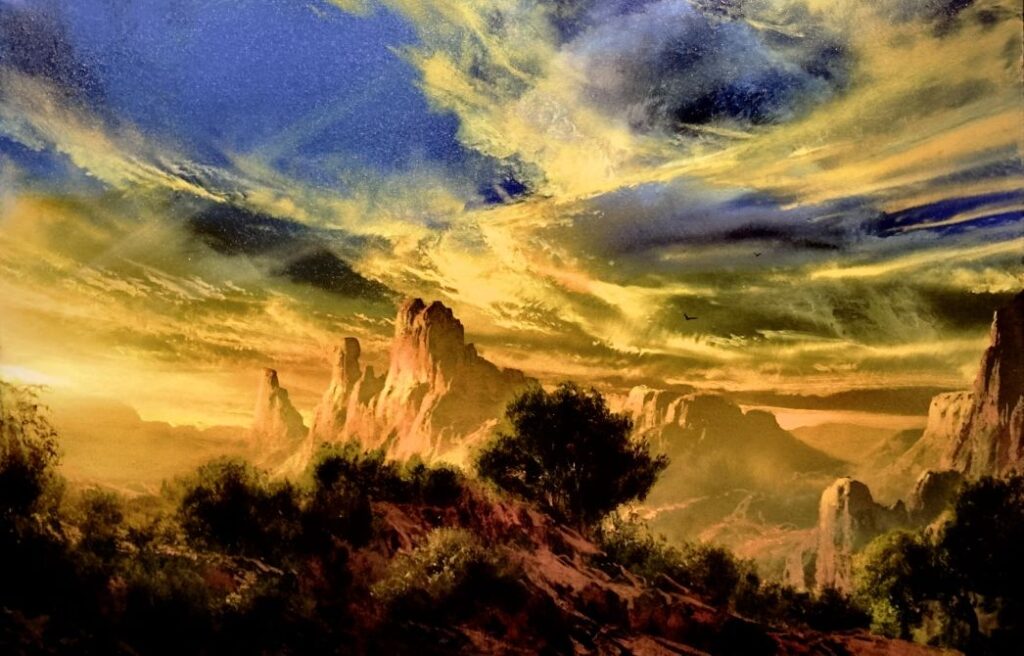

For decades, acclaimed landscape artist Dale Terbush has invited viewers into worlds that exist somewhere between memory, imagination and wonder. Known for his luminous waterfalls, mist-shrouded mountains, and dramatic vistas, Dale creates paintings that feel both timeless and deeply personal—places that seem familiar even though they exist only in his imagination.
Remarkably, Dale is entirely self-taught. From the time he was a young boy sketching cartoon characters on the backs of unfolded Christmas cards, he knew art would be his life’s work. What began with comic books and watercolor sets evolved into a celebrated career marked by a distinctive style. Rather than working from photographs or specific locations, Dale paints from an internal landscape. As he puts it, he simply looks at the canvas and asks, “Where do you want to go?”
In this conversation, Dale reflects on his artistic journey, the creative process and the legacy he hopes his paintings will leave for generations to come.
Q&A with Dale:
When did you know art was your calling?
I was five years old. I was obsessed with being an artist since I was a little boy. I’m self-taught. I’ve never had an art lesson in my life. My sister even told me, “All you ever said was, ‘I’m going to be an artist. I’m going to be an artist.’” I think I said it so many times that the universe just caved in and accepted, “You’ve got to make this guy an artist.”
My dad, who was born during the Depression, was very much against me being an artist because the fear of me starving with a wife and two children when I was in my early 20s freaked him out. But he lived long enough to see my career do very, very well. I’ve been very fortunate.
How has your creative journey evolved?
In the beginning, when I say I found out I wanted to be an artist when I was five years old, it was cartoons. I had a little tiny metal flip box watercolor set that you just turned and had like 10 colors and a little flat brush. I would take comic books and I would unfold Christmas cards that would turn into big sheets of white paper––very good quality white paper. My family would save all the Christmas cards for me and then I’d take my little pencil and my comic books and I’d sketch Sylvester, Tweety or whoever, then fill in the colors with my watercolor set.
It was interesting, as the years went on, I had these visions in my head that were of waterfalls and mountains––just very ethereal landscapes, but I couldn’t get them out of my fingers. I ended up painting on the coast highway in Laguna Beach and somebody from New York said, “Your paintings are very reminiscent of a group of artists called the Hudson River School.” I can see where I’m an offshoot of that or how somebody would think that. But since that time, I have evolved as you should evolve.
And because I’m not looking at photographs to paint from, I’m creating imaginary landscapes. I don’t even sketch on the canvas. I’m watching stuff come out of my fingers onto the canvas and sometimes I’m as amazed at what I’m seeing…like, “Whoa, where is that coming from?”
What do you love most about the creative process?
I think it’s the magic of watching it happen. For me, my excitement is watching it just happen. Every time you paint, a bit of the information is being stored in your head. So, there comes a time when your brain has all this information about painting and all you need to do is decide that day, where do you want to go? I walk in, and I’ll look at a canvas and listen to fabulous music, and just go away.
I think what the Celebration has done for me––I’m 77 years old––I realize that I want to see more of the world and being here on a regular basis, the joy of meeting people––people who love being around the creative process. The Celebration is a mass of the creative process, whether it be jewelry, sculpture, contemporary painting, traditional painting, whatever it be, it hits you all of your senses in a couple of hours. Plus, you get to talk to the people who are obsessed with what they’re doing. I love being in the company of artists, not just Sunday painters, because the people you’re going to find here have been bitten by the art bug. They know that what they do is doing something in their life and making their life better. And hopefully, enough people feel that way about what they’re creating, that it’s this beautiful circle. You create something because you love it and then somebody walks up one day and wants to give you money for what you created, which allows you to create more, and this magnificent circle goes on and on. God bless anybody, or I should say God has blessed anybody that’s been allowed to live in that circle in this lifetime.
What is the most meaningful response someone can have to your work?
We’re here for such a short time. The journey is over when you blink. And for me now, when I’m painting, I want my work to be unique enough that in 100 years somebody may go, “I think that may be a Terbush.” If I’ve accomplished that, where somebody, 50 or 100 years from now––many years after I’ve turned to dust and blown away––can say, “Wow, that’s really cool. It wasn’t painted by a machine. That was painted by a human being where something landed in his eyes, spent a little bit in his heart, came out of his fingers.” How much better does it get than that?
What brings you back to the Celebration of Fine Art?
I’m in the studio by myself. So I spoke with friends and one of my gallery owners said, “You ought to do the tent show again and meet people.” And I thought, “You know what? I think I will.”
I did the Celebration 31 years ago when it was right behind Fashion Square downtown. So, I thought about doing it again, and it has been a joy because I’ve met people who said, “Oh, we bought one of your paintings 30 years ago. Or, we bought three of your paintings 30 years ago. My parents have your paintings in their home. Or, ‘Can I take a selfie because my mom will want to see that I’m with you?’” It just doesn’t get any better than that.