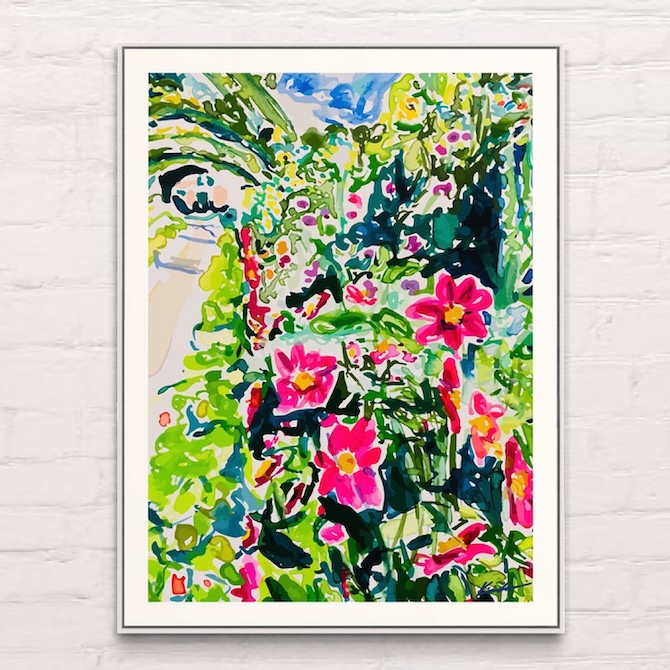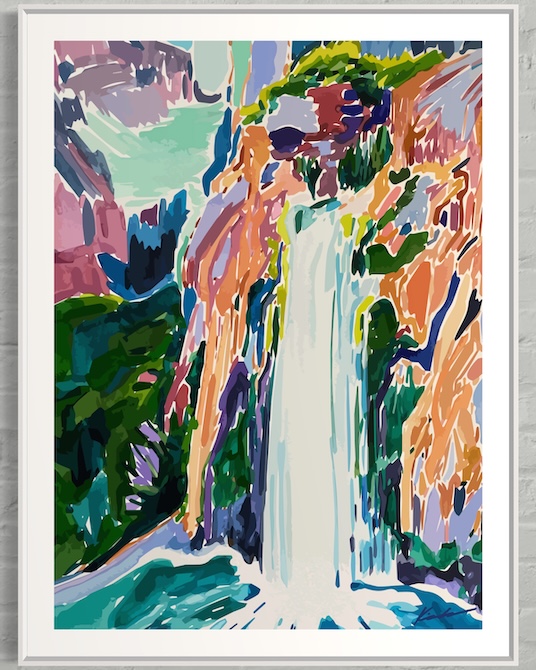

Artist Kim Lyon goes places and paints things.
A lifelong traveler, she has traveled the globe––from Kyoto to Amsterdam and Varanasi to Düsseldorf––learning, growing, connecting with people, and collecting experiences and plenty of photographs. With each return home, Kim would process and relive the experience through painting.
That time between travel was almost like her white space––the space between the colorful moments where she could lose herself in painting and relive her travels. Though she’d been painting nearly her entire life, it wasn’t until adulthood that Kim found her way to watercolor. She liked the looseness of the medium and the challenge of minding the white space.
As it turns out, that idea of “white space” was prevalent in another area of her life. Kim had returned to school to earn an MFA in visual communication, and in graphic design, white space is regarded as an essential, active element. Eventually, Kim figured out a way to connect this thread that seemed to be woven through her three passions: travel, watercolor and graphic design.
The result was digitally rendered watercolor paintings that burst with color and can be created on a large format.
In this interview, Kim shares how she developed this process and what she loves most about the process.
Q&A with Kim:
When did you know art was your calling?
Probably subconsciously, when I was five. I’ve been painting and drawing for 45 years. My mom put me in art classes when I was five and it’s just always been my passion.
How has your creative journey evolved?
It was really impacted by my graphic design experience because when I learned graphic design, I really learned about process, and iteration and prototyping. So, what I do now with my watercolors, instead of getting attached to working on a painting, if it feels like it’s not working, I just start over. So I do a lot of iterations. And so that aspect of what I learned through my MFA and visual communication design was the iterative process and not to be afraid of starting over. I do that a lot with the watercolor. Whereas when I used to paint with acrylic and oil, I could go over something that I didn’t think was working and I could change it. I find that tricky with watercolor, so now I just start over and I keep working on something until it works.
How did you develop your unique style?
A lot of my paintings were always travel inspired. Even when I was young, I was an exchange student and when I would come back, I would paint the things I saw. So the subject matter was kind of always the same, but as far as the style with the watercolors, I gained more knowledge when I worked on my master’s in visual communication design. I learned more about graphic design and the principles and elements. I think that had an influence on how I painted with the watercolors.
So my process is a mixed-media process with watercolor and graphic design, where I hand paint with watercolors. I use Japanese watercolors on hot press paper because the hot press paper is really smooth and I don’t want a lot of texture in the work because I take a photo of it, then upload that photo into Adobe Illustrator. In Adobe Illustrator, I convert all the pixels in the photograph to vector, which just means it’s digital. And when something’s digital, you can expand it as big as you want without losing any resolution. So, with the settings that I developed, I combine all of the vector shapes into larger shapes and it brings the colors out as well. I’ve reduced the corners and the lines so it retains a flowy watercolor-type feel, a painterly feel, but it’s also graphic design. So that’s how these become so vibrant and big.
How do you find subjects to paint?
Most of my subject matter is something that I’ve seen in person. I moved to Arizona five and a half years ago, so a lot of my artwork is the desert. I’ve wanted to live in Arizona and paint since I was 13. My family brought us out here on spring break and I fell in love with the Sonoran Desert. All of my art after that was the Sonoran Desert. So, it just took me a roundabout way to get out here and be painting the desert, but I’m here now and loving it. Otherwise, it’s all travel related––places I’ve been and explored and places that have changed me and impacted my life in some way, which is pretty much everywhere.
What do you love most about the creative process?
The freedom to play with color and shape and form and movement and flow. And when I’m really in the zone, it’s like I’m somewhere else entirely. I’m just in that state of creating and I love that.
What has been the most meaningful response to your work?
I’m often told by people who come and view my work that the pieces make them happy. It’s a huge honor. I do hope it inspires people to go and experience the beauty in the world because I think there’s just so much out there. Go see the world and experience it, and all the culture and people and the landscapes. There are a lot of beautiful things to go and see and experience.
What brings you to the Celebration of Fine Art?
I was looking for more community, a stable community to come to and have people around me every day. I love being here for that. Not only the people who come in and visit the event, but all the amazing artists with whom I get to share this experience with as well. I’m really excited to have some community.