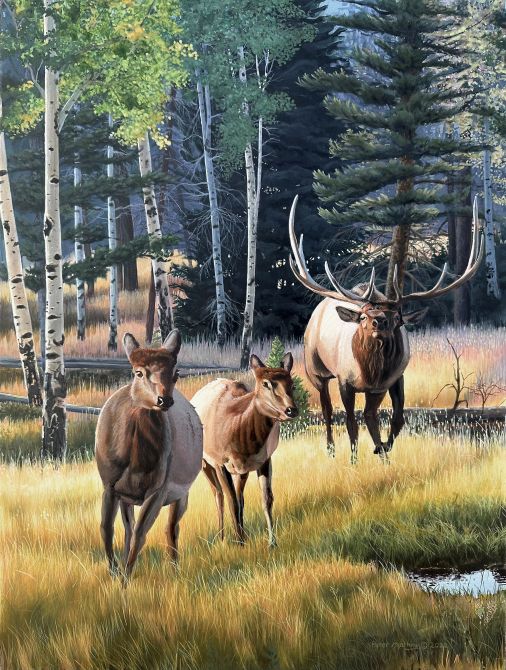

Peter Mathios developed a deep connection to nature at a young age, and when he wasn’t out exploring it, he was daydreaming about it and drawing it. Drawing soon gave way to painting and over the years, Peter has honed his ability to create highly realistic works that draw the viewer into the scene––allowing them to feel the essence and energy of the place.
His goal is to reconnect people with nature and help them experience the peace, beauty and wildness that can only be found in the natural world. And through his method of applying thin layers of acrylic washes, Peter is able to portray intricate details such as the individual blades of grass where bison are grazing or the fur of their coats, or the crests and ripples of a river. This gives the illusion of almost stepping directly into the scene.
And that’s exactly what Peter wants––he wants his art to help reconnect people to the awe-inspiring, peaceful beauty and energy that emanates in the wild. It’s beauty that he experiences firsthand and is driven to capture that experience and share it with others.
“Being outside and feeling that spark of inspiration, that ‘aha’ moment,” Peter said. “There’s something to that––it strikes me personally in my soul and I feel compelled to share it.”
In this interview, Peter describes some of the techniques he uses to create his realistic, immersive pieces and how he finds his subject matter.
Q&A with Peter:
When did you know art was your calling?
I’ve drawn ever since I was little. For as long as I can remember, I’ve drawn, and specifically drawn wildlife. As far as knowing it was my calling…I think it was sometime just before high school or in high school. That’s when I knew it could be done for a living and I locked in.
What inspired you to focus on outdoor adventure?
The inspiration comes from hunting with my dad when I was a little kid. I loved being out there so much that when hunting season was over or when school was in session, I found myself daydreaming about it. That’s how the drawing started and it grew from there. I’ve always known wildlife was what I wanted to do, and then I started seeing artists like Robert Bateman and that they could do it for a living, and knew that’s what I wanted to do. But nature has always been my passion and my direction and focus.
How do you find subjects to paint?
My wife and I love outdoor adventure, so we’re always looking to go explore areas, especially mountains. We hike and backpack, and have spent a lot of time trail running and just venturing in the mountains. So, whenever inspiration hits, that’s usually how a painting develops. Whenever I’m out, I’m taking pictures either with my phone or I bring my camera.
My painting, “Legacy of the Lamar,” was in Yellowstone National Park in the Lamar Valley, and to me, though I’ve been to Yellowstone over 10 times, the Lamar Valley feels like it hearkens back to maybe days gone by of how wildlife used to be in this country. There are grizzly bears, bison, elk, deer, moose, pronghorn, and they all seem to inhabit this valley. Sometimes you can see them all at once, almost like a Serengeti experience. In this particular painting, the way the moose were grazing and moving through the shadows of the late afternoon along the river, the foreground shadows with the background light and the way the river is going back––that’s what inspired this painting.
What do you love most about the creative process?
Being outside and feeling that spark of inspiration, that ‘aha’ moment. There’s something to that––it strikes me personally in my soul and I feel compelled to share it. I think that’s my favorite part. And then during the planning phase, I’ll do some sketches for paintings sometimes, and other times the inspiration is so dramatic that I just jump right in and start painting.
What has been the most meaningful response to your work?
I’ve had people come to tears looking at it. When a piece moves somebody and strikes them, either it’s a memory or an experience they’ve had, they just come to tears. That’s the most meaningful for sure. And of course, when someone purchases something, that’s meaningful too, because they’re putting out their hard-earned money to have it and experience that forever. So that’s very meaningful too.
What brought you to the Celebration of Fine Art?
I heard about it on a podcast and I had just retired early from teaching, and thought, ‘I wonder if I should apply to that?” I thought it would be an adventure to go down to Arizona for several months and spend time in the desert and do this show. So I applied!