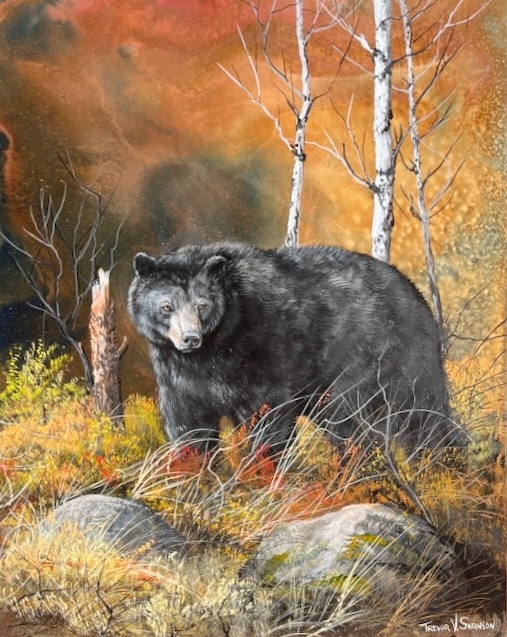

For artist Trevor Swanson, there are no better words than, “I feel like I’m there.” An avid outdoors person, Trevor is happiest when he’s either out in nature or painting nature. Luckily for him, the two go hand-in-hand.
Nature provides Trevor with an endless supply of magical moments and chance encounters that eventually make it into his artwork. And for him, experiencing and feeling these moments firsthand is what allows him to bring viewers into the scene with him.
“I’m compelled and drawn to paint scenes and settings from nature because that is where I find myself most at peace and in touch with the world,” Trevor said. “I also have a sense of wonder about the depth of variety and interesting things that share our world. I feel fortunate that I’ve had the opportunity to travel the globe and experience firsthand so many incredible things. There is a magic in the moments of observation, whether it’s a chipmunk, a grizzly or an elephant, that makes me feel alive and connected to something more. It is these moments that become some of the most interesting and sometimes challenging to portray and recreate.”
It’s also Trevor’s unique style––often using patinas on metal as the backdrop for his oil paintings––that captures the energy, mystery and serenity that exists in nature. Over the years, working with patina in its somewhat unpredictable nature has opened him to exploring a different color palette and color combinations––ones that Trevor feels are more in tune with nature.
In this interview, Trevor shares how he infuses his paintings with a sense of place and what he has come to learn about color.
Q&A with Trevor:
When did you know art was your calling?
Not until my 20s. I was struggling in school. I kept taking the same math class over and over and having a great time doing art, but it wasn’t something I ever really thought I would pursue. But I also come from a whole background of artists. My great-grandfather was a painter. My dad, my uncle, and a cousin were all painters. So, it was something that was always there, but it never dawned on me that maybe this is something I should pursue.
I think most people in my family knew that this was going to be what I would end up doing, though. My parents definitely knew art was where I was going, but they let me be free to choose and see what other paths were out there. I was a scuba instructor for a while and just loved it, but that was a hard way to make a living and it was taking me away from family and people. So, I came back to art. And after that first sale of a painting––somebody wanted to spend their money on something I created––there’s an immense joy that comes with that, and I was hooked.
What drew you to your subject matter?
Early on, my dad and my uncle came to art through the things they loved. My uncle studied socioeconomics and loved Native Americans and their story. So, when he started to paint them, it just clicked. That was his subject. He’d learn their stories and their families. They became his people. My dad was a taxidermist for a long time and loved animals. He loved Africa specifically. So, that was always his passion. One of the things I love is the outdoors––being in nature. I’m just as happy seeing a chipmunk or a squirrel as I am seeing a bull moose.
There are moments of magic like that a lot. It all happens when you’re out there, it’s peaceful, the world has gone away, and you see these moments of beauty. But that’s one of the things they told me early on, is find a subject that you’re passionate about and you will never struggle to find things to paint. There’s something always there. It’s a moment or places that give you peace. So as I’m sharing these different experiences, this career has allowed me to do all kinds of traveling and be in all kinds of interesting places. I get to see all of this, whether it’s a beautiful tree or the way the sun is lying on the mountains as a bear is walking down. My work is me sharing the stories of places I’ve been and things I’ve seen.
How has your creative journey evolved?
Through working with patinas, I’ve gotten a lot more comfortable with color. Now, my whole palette and all the colors I use are very much based on nature. If it’s a tube of paint that you wouldn’t find in nature, I won’t use it. All of the different colors that work with the patinas are very earthy and natural––the colors of water, sky color, earth color, etc. Those combinations come together organically on the metal. So, it has opened all these doors––seeing all of the colors that would actually work well together. So, my traditional work on canvas has changed and grown alongside what I’m doing with the patinas. And so much of the patina is kind of out of my control. So I’m not forcing it and trying to make these colors work together. It just happens naturally on the metal with that acid interaction. It naturally presents the colors that actually work well together––colors that I never would have thought of putting together before.
How do you capture the essence of the moment in your paintings?
Making notes, taking that photo––just capturing that moment. I kind of pretend my eyes are the camera, taking a long blink to help seed it into my mind. I think about what was beautiful about that moment? What is it that I want to share? Is it the whole scene? Is it the light on the bear? Is it the grass? Is it how the wind was moving? Because a lot of what I’m doing is telling different stories. And sometimes it happens by accident. For instance, I have a quail painting that came about after I slid down the gravel side of a rock and scared all these quail that jumped and went into this bush. They sat there looking at me like, “What is that guy doing?”. And that turned out to be this beautiful painting. I realized, as I’m sitting there on my butt and scratched up from the gravel, that “Oh, this is the painting right here.”
You have to be in the moment and aware enough to see it, take note and then go forward with it. A lot of what I’ve done over the years is train myself to remember moments. What is it about this moment that is going to work its way back into a painting, whether it’s a light or a flower or a rock?
My biggest compliment is when somebody looks at a piece of my art and says, “I feel like I’m there or I feel like I’ve been there.” It doesn’t matter if they’ve ever been to wherever the source material is from. To have somebody say, “You have brought me to this place with you,” that’s the ultimate compliment. That’s what I’m looking for––that moment of connection. It still gives me the chills when someone says, “I don’t know what that is, but it’s beautiful. And I feel like I’m right there with you, seeing this, experiencing this.” That the greatest moment.
What do you love most about the creative process?
I love the beginning and the end. At the beginning, you’ve got all this potential. There’s a clean, bare piece of metal in front of you or a white canvas that’s just waiting for all this stuff to happen and there’s something about that potential. Then, once you delve into it, I kind of go into third gear, just working my way through all those issues and making sure all the pieces come together, but I’m seeing it for the pieces instead of as a whole. So, it’s like you start here, you can see the whole picture and then you delve into it, take it all apart and then recreate all that imagery with paint again, like building a puzzle and then all of a sudden at the very end you lean back and just look at it and it’s like, “Ok, how did it work?” There’s always a surprise, too. But, at that moment, it all comes full circle. So those two things have such an interesting balance with the end of the piece and the beginning––seeing all the potential and feeling it all come together the way it’s supposed to.
What brings you back to the Celebration of Fine Art?
The people. I really enjoy the family that I’ve built here. These are some of my best friends in life. There’s something about the people here who bring the spirit, energy, the giving and sharing of information, and the challenging of each other. The clients are fantastic. The people who come through here are looking for that joy. They want to be here. They’re excited about it. But so much of it is that the group of artists, the people who run the show, they’ve really become a family. There’s such an interesting connection here with people because it’s like it’s our tribe of misfits and we all fit together.