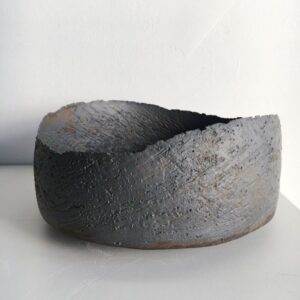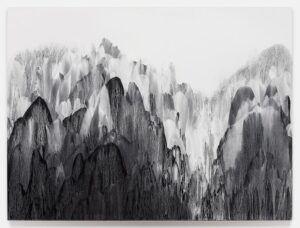

Erica Iman’s sculptural vessels, paintings and ceramic wall pieces go miles beyond the visual surface. They feel rooted––deeply connected to the earth. They evoke a sense of calm and peace, perhaps because they are made of the very elements from which we all originated: Earth.
From childhood, Erica was drawn to nature. To her, dirt, stones, sticks and other earthen fragments were not castaways. They were objects that beckoned to be made into something creative. A challenge perhaps, but also an opportunity to connect to nature.
“I was that kid who sat alone, digging in the dirt and making little creatures and things out of pieces of wood or rocks that I found,” Erica said. “I was always curious about how things worked and how you could turn dirt into mud and make it into something. It just grew from there.”
And she continues to find inspiration in nature and exploring the world. Expressing these shapes and characteristics in her art has been a way for her to make sense of these natural wonders, from the Yuba stones of Northern California to the fragments you might find on the forest floor and even the desiccation cracks of a desert playa––inspiration abounds.
In this interview, Erica shares how her love for clay developed, how her style has evolved and the other surprising natural element she uses to create her paintings.
Q&A with Erica:
When did you know art was your calling?
I was always interested in making things. I was that kid who sat alone, digging in the dirt a little bit and I would start making little creatures and things out of pieces of wood or little rocks that I found. I was always curious about how things worked and how you could turn the dirt into mud and make it into something. It really just grew from there.
Also, there’s this interesting curiosity as far as exploring the world in that sense––the ideas of the world and how to live in this environment. What are these mountains and trees and all of the environment around us, and interacting with those and the materials. It’s this way to explore for me through life and understand the world around me.
What endeared you to ceramics?
I started in art education and went into teaching. I taught for a few years, and every time I would teach clay, there was something about it that I really connected to and I just thought, “I want more of this.”
I ended up going back to school to get my BFA in ceramics specifically. I had a really amazing professor during that time who really spoke to me. The way he worked with the clay was very experimental, though he would bring in traditional elements, especially from traditional Japanese pottery. The way he talked about the work was very poetic and it really drew me into that emotional magnetism that art can have, and helped me understand how valuable that was in making the work. That was my introduction into ceramics specifically and working with clay.
From there, I went on to get my master’s degree and work with some other potters as an apprentice.
What draws you to raw earth material?
There’s something about clay that is just so malleable and it’s so immediate. It’s such a raw material, just taken from the earth. You can push it around and it instantly responds to that. It shows the human marks so well. You could have this slight little push of the finger and it will be the freshest mark. You see the hand work in it and that immediacy. So, that was always very exciting to me––to be able to get my ideas out quickly in the clay.
Again, I was always drawn to digging in the dirt and collecting rocks and sticks and all kinds of things. There’s something innate about the material in the way that you can sculpt it and it looks both delicate but also very strong, like these raw materials. Then, creating something out of it that you can bring into your home that has a certain emotion to it and a connection to nature.
How has your creative journey evolved?
I started in clay and did some apprenticeships. There was a potter, Hiroshi Ogawa, out in Oregon who I would do wood firing with, which required feeding the kiln 24 hours, day and night, for four days straight. The kiln was decorating the piece itself. The flame and the ash would land on the surface, and the flame would create some flashing marks. And, in the fire box, where you’re throwing all of the wood and building up this ash pit, a lot of the pieces that came out of that ashpit were the ones that really struck me. So, then I started evolving into doing more sculptural work because of that. Those really heavy textures weren’t as suitable to functional pottery, which is what I was doing at the time. I started going a little bit more textured and sculptural, then eventually was doing purely sculpture.
I’ve balanced back and forth a little bit to vessel form. So now, I’m not necessarily functional pottery, but not just pure sculpture––sculptural vessels. Over time, I started exploring the raw materials on their own. I started testing a lot of oxides––iron oxides, copper oxides, clay slips––all of the raw materials I was using in my clay work. I started testing them on paper, mixing them with water. Eventually, that led to the paintings, which are made of black iron oxide, one of the raw ingredients that I use in my colorants for my ceramic black glazes. So, I evolved into doing paintings and two-dimensional work now, too.
What do you love most about the creative process?
Once I start working on a piece. I love coming up with ideas and sketches, and often I’ll create small maquettes, and that’s a very exciting moment in the process. But once I start working on a piece, that’s when I really lose myself quite a bit and feel like I’m working in my own little world. That time where I’m creating and focused, and maybe doing something repetitive, but I’m really focused on the piece, it’s really a meditative time. It’s an immersive experience in the work, and trying to find what in the material, form and surface is going to come together to create the finish of this piece. It’s trying to find the beautiful form within the wall or the edge, and the textures. That time, which a lot of people talk about as that “flow state”, is really a wonderful experience to be a part of. And it’s just a very tactile, full-body immersive experience.
What is the most rewarding aspect of your work?
Doing shows has brought so much to my work and my life. I ended up getting to travel around the United States doing lots of different shows, and that has been a good experience as far as getting to know people all over and exposure for my work. Everything from the desert environment to the West Coast with its dramatic Pacific coastlines and broken bluff stones on the edge has played into my work as well. All of these places that I’ve traveled to have influenced the work. But then, of course, the people. I get to interact with people directly, and the response and feedback, and seeing what they are connecting to has been a really amazing experience. To be able to have that feedback and connection with people who are interested in it.
What inspires your work?
Big vistas and awe-inspiring landscapes have always played in. But I also find that the tiny little fragments––the macro/micro––the little fragments that I pick up along a trail. The broken chunks of rock and little pieces of moss, and looking at texture and light on those surfaces, those types of things play heavily into my work. Often, I’ll take those little pieces––I have a full collection of those in my studio––and try to pull them into the work, into different textures or form.
What brought you to the Celebration of Fine Art?
It has such an amazing community of artists that feels very warm and welcoming. Everyone is so supportive. And the amazing community connections here. It feels like the people who come to visit this show have come for years. It feels like a community. And they’re here to see the work and the artists evolve, which is a neat experience.