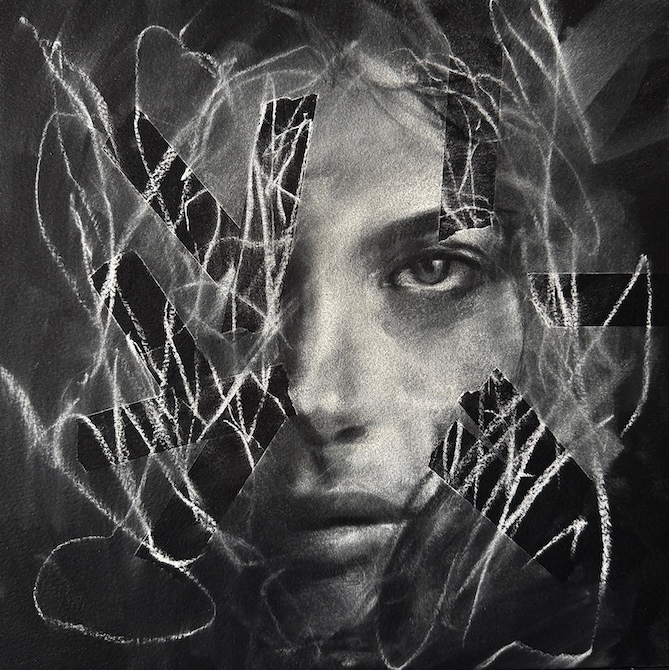

Growing up, Josh Hernandez was known as the “kid who draws”. He naturally gravitated to sketchbooks rather than textbooks. It was his solace, and he knew he’d grow up to work in the creative industry in some capacity. But the exact path had yet to crystallize in Josh’s mind.
He went on to study graphic design, but continued taking art classes and that eventually led him to a medium he had yet to explore––a medium that would forever change his trajectory.
“I’ve always drawn and painted with a lot of different media, and in college I was taking some life drawing classes, and you have to use charcoal in those,” Josh said. “I never really knew how to use it before that, but I found I was able to get really expressive with it. So, naturally, I kept creating in charcoal and it became my favorite thing to do in my spare time.”
Josh liked the challenge of charcoal and the more he worked with it, the more he started to find his voice. Soon, it became his primary medium. And though he was working full-time as a graphic designer, he spent his spare time honing his charcoal craft and developing a way to make the work archival without having to put it behind glass.
After several years, he finally cracked the code on how to put charcoal on canvas and make it as long-term as an oil painting.
In this interview, Josh shares how he makes his work archival, why he uses charcoal and how he uses his subject matter to create impact.
Q&A with Josh:
When did you know art was your calling?
I grew up drawing and creating. I always wanted to be in the creative industry somehow. I went the graphic design route when I went to school, then worked in that world for a while. I loved it, but I actually shared my artwork online one day and it really blew up. As I shared it more and shared my process, it blew up more. So, I just naturally went that route with the demand growing for my artwork and selling my artwork. And now it’s all I do.
How did you develop your unique style?
The way I’ve worked recently is a way that I’ve been trying to figure out for years. There aren’t really any artists that work with charcoal on canvas, especially not many artists that have cracked the code with…actually, I don’t even know of any who’ve cracked the code with making charcoal on canvas stay there and be as archival as an oil painting or a museum painting. I’ve developed a process over the years that has taken me a lot of trial and error to work on a raw canvas surface, and seal that over with an assortment of varnishes and finishes to be able to have that be protected for good. It’s not removable. It’s very permanent and it’s protected. There is no smudging of the charcoal anymore once it’s sealed. That’s why it’s presented in this way on the canvas and it’s completely covered.
What has been the most meaningful response to your work?
My work really revolves a lot around my faith. My faith is something that really dictates and controls a lot of my life in a very beautiful way. So, whenever I have work that reflects that, even the work that isn’t directly Christian subject matter, for me, is very impacted by my faith. When somebody sees that and recognizes the differences in their own faith journey because of something they’ve seen in my work, I find that really, really moving. I’ve had really good conversations about the impact that some of the work has had on somebody’s life and their faith journey and then just bringing them back to Christ or whatever that looks like for them. That is very powerful. And if it’s powerful for them, it’s really moving to me that we’re able to accomplish that through the work.
What do you love most about the creative process?
I’ve always loved creating since I was a little kid. I think making something different, being expressive in the way I feel and the way that I want to portray things and even explore different subject matter is what I really love. I find charcoal to be really useful for that. It’s so expressive. You can go really deep, really dark, and there’s lots of contrast, lots of value change and being able to create the illusion of something. Sometimes creating the illusion of light and shadow, I find that really challenging, but really beautiful. So implementing that in the work is something I’m really passionate about.
I also love challenging myself. One of the ways I try to challenge myself is through not using color and narrowing down the things that I can work with. I try not to use three-dimensional effects to captivate the viewer. Instead, I use a lot of value changes and different subject matter or forms that create illusions to form, or emotional responses to the work. So I really have to push the boundaries in the value, form and subject matter categories, rather than depend on color to draw someone in.
What brought you to the Celebration of Fine Art?
People mostly find my work through online avenues like Instagram or TikTok or YouTube. So, this is a cool opportunity for me to get to know people here, get to know other artists, and get to know other collectors. So, for me, this is branching out and just being a little bit more personal.