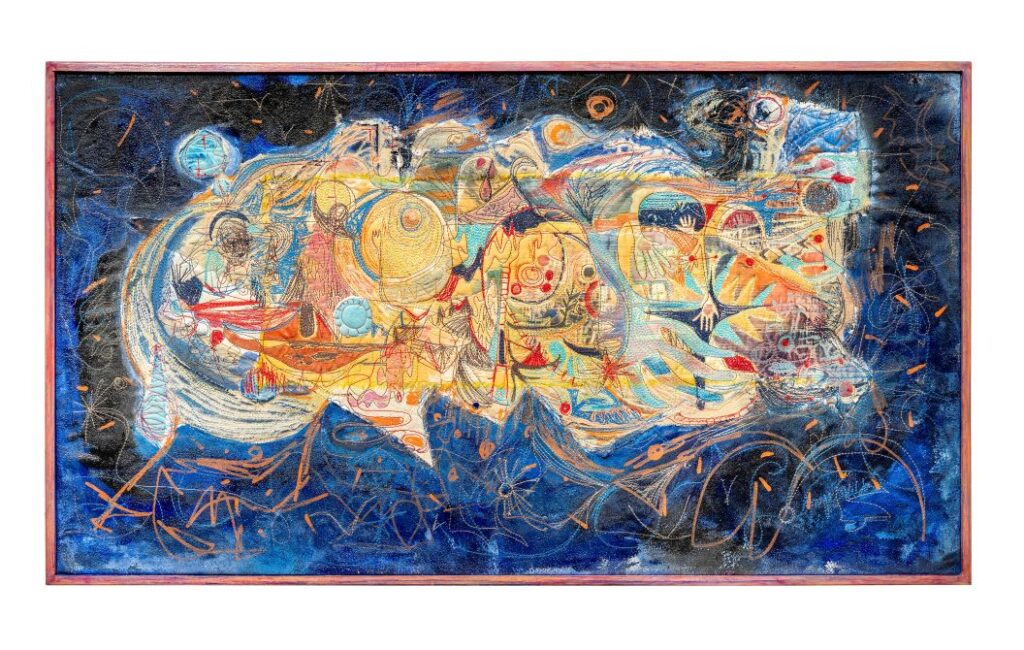

At first glance, Jenny Welden’s art may appear as an abstract painting, but move in closer and you discover a wonderfully intricate world that incorporates no short of five to seven art forms and media. Though there is painting in her pieces, they are actually considered multi-media tapestries––each one like a wunderkammer of curiosities and artistic treasures.
This work is a fusion of Jenny’s various interests and studies––from sewing to painting, embroidery to multi-immersion fabric dying, and dance to collage. Each piece tells a rich story, using layers of fabric, stitching and color to convey a message.
“I say that I had at least seven different pots on the stove,” Jenny said. “There was weaving, printing, dying, painting, drawing and collage. There’s also ballroom dance and somatics, bodily movement practice. I had all these different pots on the stove, and then eventually I started combining them into a soup. And that’s what this is. This is my soup.”
In this interview, Jenny shares how she developed this very unique art form, how pieces come together and how she infuses story into each one.
Q&A with Jenny:
When did you know art was your calling?
Sometime in college. I was always making since a very young age. And growing up, I learned that artists can’t make a living, but in college, I had this wonderful chemistry professor and academic advisor. He saw my art portfolio and said, “Why aren’t you taking any art classes? You’re an artist.”
So, throughout college, he kept on encouraging me to take classes in art. At some point, I finally took one art class and then another class. And then my academic college advisor told me, “One day you’re going to come back to this school as a guest speaker and you’re going to be a professional artist.” I’m now a professional artist. I think that voice of support and speaking life into my future was a big turning point for me to be able to own that destiny for myself and to start walking in it.
How has your creative journey evolved?
I did some classical oil painting with this wonderful mentor from the Angel Academy of Art in Florence. Then, when I went to school, I started exploring art classes in various mediums. But as a kid, I would volunteer in a historical reenactment museum and the ladies there would give me their scrap fabrics and I would just play with them and put them together. Initially, it was just gluing them together. Then they taught me how to use a needle and thread. It was always the remnants––leftovers from other people’s projects––and I would turn them into something exciting.
I’m still doing that in many ways––there are so many rescued fabrics and fibers in my pieces. As I continued to work, I began combining these different loves.
I say that I had at least seven different pots on the stove. There was weaving, printing, dying, painting, drawing and collage. There’s also ballroom dance and somatics––bodily movement practice. I had all these different pots on the stove, and then eventually I started combining them into a soup. And that’s what this is. This is my soup.
How do your compositions come together?
There’s a lot of multi-immersion dye work. And when I was working in oil painting, learning the glazing process of that classical style, I would layer translucent colors over one another. At some point, I started applying that concept to the die work. So this multi-immersion dye work creates this beautiful nuance of color and a depth of color that can’t be achieved any other way. Then I start to paint, and it’s a very free, intuitive way of painting. It’s abstract expressionism, and those layers start to build up, and then I may pull it onto my machine and embroider. Then I’m stitching, and every single stitch is produced through the movements of my body. So there’s also a dance component.
Then, rescued or hand-dyed fibers are also added. Then I might start to destroy parts of the work and cut away, so there are segments that have actually been removed to reveal other layers.
How do your textiles help weave the story?
They all have their own stories. Some of them come from mills that no longer exist. Some of them are deadstock fabrics, which means that they’re from some industry and they’re remnants that will be thrown away. But the fabric itself is perfectly good. So, I often will source it that way or sometimes from loved ones, but they also have a lot of personal significance to me.
For instance, there’s a component from a modular work called “12 Hands” that has a really chunky piece [of fabric] that creates a pathway through the work, and it’s actually a piece of a hospital blanket. Many of the fabrics are pieces of my own memoir––pieces of my own story. I had a very significant health experience, a near-death experience. And I have since used remnants from that time in my work. So there are all kinds of hidden, very deeply personal things inside each piece. So, besides the processes that go into it that make each one totally unique, there are also these little bits of myself, so no piece could ever be replicated.
What do you love most about the creative process?
I have this amazing dialogue with the work and also with this inner voice, and that mysterious process is my favorite. When I’m creating the work, I don’t have a plan or a vision for what it’s going to be, and instead I’m listening. It’s a listening practice. It’s also a practice where I’m almost the medium, and trying to see what the work needs and what the work wants. Then I bring that forward. When I work at my machine, I can only ever see this small section at a time, and unveiling the giant piece, that’s definitely a favorite component of the practice.
What brought you to the Celebration of Fine Art?
I had a friend of a friend who had been to the show and said, “You have to come and maybe someday exhibit here.” So I came and I instantly knew this is a place that I wanted to be. That was 10 years ago. And this past year, I felt ready in my life and work to come. So I applied and I got in, and it feels like a great fit.