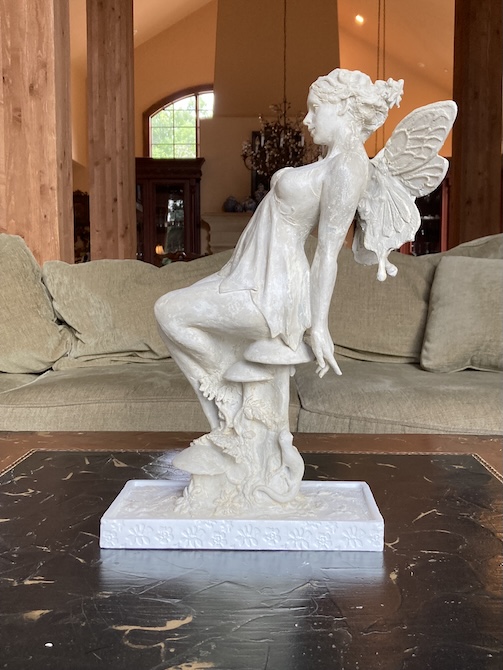

For sculpture artist Laura Lee Stay, blocks of stone and clay hold rich stories waiting to be told, and she uses these materials to portray snapshots of life in 3D. A lifelong artist, Laura Lee actually started out painting, but only because she had yet to be introduced to sculpture. But in college, that all changed.
From her first interaction with clay during a college class, she knew that was her life’s calling. More than three decades later, Laura Lee still loves every aspect of sculpting, though she admits it’s not the easiest profession. It’s a practice of patience, multiple steps, lifting heavy objects and materials, and in the case of carving stone, it requires a deft hand––one misstep could completely change the vision of the piece.
But Laura Lee loves it all and relishes the meticulous details that go into each step, from working with live models so she gets the anatomy and energy just right to taking annual trips to Italy to work from the best materials.
In this interview, Laura Lee shares what she loves about sculpture and what she created during her most recent trip to Italy.
Q&A with Laura Lee:
When did you know art was your calling?
I started when I was 11 years old and I was like a Van Gogh. I painted so much that I had art under beds, on the walls, and my family was really sweet. They loved that I did all this art. My parents were very supportive. I did go on to study it in school and I got a master’s degree in sculpture from Brigham Young University. So, I had a lot of academic training, which keeps me very grounded in my traditional methods of making art with the figure.
How has your creative journey evolved?
I didn’t have a clue about sculpture growing up. I just loved painting and I learned Russian expressionist from a really good private teacher. I never took any painting classes or art classes in high school. I just took private classes. And over time, I created such a portfolio that I got to go to college on a scholarship. In the process of taking classes in college, I took sculpture and once I took that, there was no return. I love sculpture. I’m very 3D.
I’ve gone on to create huge sculptures––commercial work, and several towns and cities have parks with my sculptures in them. I’ve gotten a lot of opportunity. I’ve been really fortunate.
What do you love most about the creative process?
Everything. It is arduous. I’m not going to make it sound glamorous. From the beginning to the end, it’s an intense profession. You never cannot put all your heart into even the slightest part of it.
For instance, this sculpture, “Caduceus”, is about 95% finished. She’s in clay and this clay does not dry. It’s oil clay, so it’s always moldable. And I build it pinch by pinch, just putting one little piece on at a time, covering the wire structure that’s holding this into its shape. I have to form things on top of this structure, but the whole thing has taken over nine months so far. [The clay sculptures are then used to create molds for the finished bronze sculpture.]
Why do you take annual trips to Italy?
I go to Pietrasanta in Tuscany every year. The town is known for sculpture and carving. I go there because they have Carrara marble there. The piece I carved while there came from the same mountain that Michelangelo got his marble for the “David”.
Carrara marble has lovely teardrop markings in the stone and the stone I got doesn’t have any fractures in it. It’s just a solid piece, a block of marble. It took me three months of working really hard, like nine to 10-hour days. You can only get a three-month visa, so I had three months to pull this off. I shipped it back and worked on it more in my own studio.
Carving a marble piece is quite extensive. I start out with a maquette, which is a small version of the sculpture. They say Michelangelo discovered the piece in the marble, which is sort of true, but you have an idea of where you’re going.
In the maquette, however, I have her hands reaching. She’s kind of in a giving pose, but that doesn’t work so well when you carve a marble because the marble is fragile, especially if you have appendages that are just hanging out there in space. So, I modeled it to have a shell. So the process actually dictates more of what the sculpture’s going to be than you would realize. In this case, I had to make something for her to hold that would connect to the rock underneath her. So I made a beautiful conch shell and put a hole in it so it can have a water feature. She’s called “Balance”.
This sculpture weighs 450 pounds, but the block it came out of was over 600 pounds. I removed 200 pounds of material to get her out, and I’m still doing it with a lot of trepidation. I think about these things very seriously. I know that this stone was in a mountain for eons, just sitting there patiently. So when I do this, I take it very seriously because she’s been waiting so patiently to become a sculpture, so I love to be kind to her and humbly respect my stone.
What brings you back to the Celebration of Fine Art?
I love this environment. I love being here. I can work while I’m here and I can actually help educate others about the sculpture process––that it starts in clay, then I have to make them into bronze, which is about another six months of foundry work. It helps people appreciate my process and the time it takes, which is why bronzes cost what they cost and are a good investment.
I also come here because this show is quality and more people who want art come to this show. You just don’t find that sitting in your studio. So I love it.